← dojo.be · English · Nederlands
Joost De Wulf — The Journey
GRATITUDE
This journey would not have been possible without the countless teachers, fellow students and collaborators who shared their knowledge, time and generosity. Thank you also to all the unnamed friends who offered space, music, food, and encouragement over the years. Your support has shaped this ever‑unfolding path.
I am especially deeply grateful to Tomita Seiji — whose universal principle has been the cornerstone of my practice — and to Mukesh Gupta, whose presence and dialogue have profoundly deepened my understanding of listening and awareness.
The sharp, exacting sword of iaijutsu taught by Ben sensei (and Yamakoshi sensei and the many masters before them who have passed on their skill and insight) continues to challenge me in the most demanding way, sharpening both technique and spirit.
Most importantly, I owe everything to my parents and to my closest circle — Kim, Marieken and Andreas. Their unwavering support, love and belief made every step of this path possible.
The Path at a Glance
Key moments — the full story follows below.
| 1981 | Hatha yoga (Eric Gomes). |
| First encounter with J. Krishnamurti's teachings. | |
| 1983 | Began aikido (Sakura Mariakerke). |
| 1985 | Taijiquan — Liu Wai-sang lineage. |
| 1986 | MA Japanese & Classical Chinese, UGent (graduated 1993). |
| 1988 | First encounter with zazen (Roland Rech, Deshimaru lineage). |
| 1991 | Got a Black belt aikido — Georges Rousseau (Brussels Aikido & Budo Federation). |
| 1992 | Regular student of Tomita Seiji Shihan — transformative shift. |
| 1993 | Founded BSJ Ghent with Henk Coudenys. |
| Began aiki-iai with Tomita. | |
| 1997 | Japan — three months of iaijutsu with Yamakoshi Masaki (20th generation). |
| 1999 | De Bakermat dojo, Sint-Amandsberg (1999–2002). |
| 2002 | Retreats with P. Krishna — Krishnamurti inquiry deepens. |
| 2004 | Founded Suishin dojo, Lembeke. |
| 2010 | Benoît de Spoelberch returns from Japan — koryu iaijutsu begins. |
| 2012 | Meeting with Mukesh Gupta — shift from thought-based to attention-based living. |
| 2018 | Received 5th dan aikido (Tomita Shihan). |
| 2020 | Suishin dojo passed to Filip De Smet and Greet De Baets. |
| received 3rd dan iaijutsu (Yamakoshi Masaki). | |
| 2022 | Healing taijiquan with Luc De Smet (paused 2026). |
| 2024 | Silent retreat with Edel Maex, professional training. |
| 2025 | Received 4th dan iaijutsu (Nihon Iai Renmei). |
| Teaching bi-weekly at Ban Sen Juku Brussels. | |
| 2026 | Offering Meditative walks in the forests around Bruges. |
1. THE FIRST STEPS (1981–1985)
My path began in 1981 at the Yoga Centre in Ghent, where Eric Gomes taught hatha‑yoga and where I found the books of J. Krishnamurti. Those two threads — learning through the body and self‑inquiry — became the lenses through which I would later view every practice.
Short initiation in karate (1980) and judo (1982) invited an interest in Budo (Japanese Martial Arts) and taught how to do Ukemi (rolling and falling).
In 1983 I entered aikido at Sakura Mariakerke, first with Sinia Blondin and later with Rudy Joliet. The club was a hub for the Belgian aikido; I also learnt lots from sempai Jean Pierre Coppejans, Eric Verhertbruggen, Frank & Dirk Van Glabeke. Early on we traveled together to Lille and Paris to train with Michel Bécart and invited him to our Mariakerke dojo. I trained with him from 1984–1994, though the summer school of 1987 was most intense. In 1991 I earned a shodan (first black belt) from the Belgian Aikido and Budo Federation from the hands of Georges Rousseau, Georges Gailly, etc. It was through Rousseau's influence that Tamura sensei came to teach some private seminars — and also through him that I met Philippe Voarino (1991–94).
2. UNIVERSITY YEARS (1986–1993)
While studying Japanese and Classical Chinese at Ghent University, I discovered the I Ching (Yijing) as a mirror for inner patterns. Aikido seminars with Sugano S sensei, Tamura N sensei and Yamada Y sensei broadened my technical base. I was most impressed by Kobayashi Hirokazu sensei and persisted in attending his seminars (1987–1994).
After travelling together to Japan, I have maintained a friendship and scholarly exchanges with Steven Trenson, now an associate professor at Waseda University in Tokyo and a recognised expert in Esoteric Buddhism. Our dialogues have nourished my spiritual quest, offering linguistic and conceptual insights that continue to enrich my practice.
3. A DEFINING CHOICE (1992)
A 1990 demonstration by Tomita Seiji — who combined aikido, iaijutsu and the Japanese tea ceremony — left a lasting impression. From 1992 onwards I attended regular classes from Tomita sensei and parallel seminars with Alain Peyrache. It became clear that the body could not cope with all these different approaches anymore. Tomita sensei made it clear: keep to one teacher. Translating Kisshomaru Ueshiba's old aikido manual for my master's thesis revealed a passage that perfectly echoed Tomita's principle, taking the balance through contact. By late 1993 I committed to Tomita's lessons, organised a dojo and assisted him in Ghent. This decision reshaped everything that followed.
4. BUILDING A FOUNDATION (1992–1998)
After training for about one year in the Ixelles dojo at rue Malibran, I founded together with Tomita sensei and Henk Coudenys the BSJ dojo in Ghent. Tomita's weekly classes were very enriching and intense; I taught on Thursday what we just learned on Tuesday. For five years we organised a small but dedicated community, and built a stable group of students (Marc Eliaert, Erwin Sevens, Wim Vervaeke, Steven Trenson, Jorgen Van der Beken, Joeri Gydé and many more). The foundation for a deep friendship with this sensei was ready to unfold like a delicate flower.
The first few years of teaching in Ghent, I attended Monday classes of sensei in Antwerp; sempai there were Frank van Hoeck, Mieke De Borger, Jurgen De Beule, Marij Uytdenbogaert, Theo Korn, etc.
5. KYOTO (1997)
A summer‑autumn trip to Japan (we trained aikido in Takeuchi dojo and near Kyoto station) introduced Steven Trenson and me to Yamakoshi Masaki, a 20th‑generation master of Musō Jikiden Eishin Ryū. Training with him clarified the deep historical and structural link between sword work and aikido. The journey confirmed that the earlier choice of Tomita had been right — the best of aikido teachers lived in Belgium. Many thanks to Yamakawa sensei and Tsukimoto sensei for guiding us around on this journey.
6. FINDING MY OWN WAY (1996–2002)
From 1996 I taught aikido at Capitol, a self‑defence academy in Ghent — an experience that clarified what environment aikido needs to flourish. In 1998 I resigned from BSJ Ghent to find a more independent direction.
After that, I opened a modest space in Sint‑Amandsberg — De Bakermat, the cradle — that offered aikido, taijiquan, zazen, yoga, Krishnamurti inspired activities and related arts. Financial pressure forced its closure after three years, but the spirit of seeing the connection beyond disciplines persisted. Many thanks to the many who helped to build this: Corinne Debroye, Stefaan Six, Kaatje De Porre, Paul Mussche, Brigitta Cocquyt, Dora Smeesters, Els Cottyn, Ingrid Vervondel, Marnix Vermaercke, Herman Meirhaeghe, Attila Kadar and esp. Lieven De Smedt.
During this period (2001‑02) I also taught self‑defence courses for Securitas (Securis). Here I met Jean Marie, a tai chi teacher and martial artist who kept on connecting through the years.
7. SUISHIN LEMBEKE (2004–2020)
Seeking a quieter setting, I founded Suishin dojo in the rural village of Lembeke. For fifteen years a small, stable group trained there, inspired by Tomita's universal principles. The practice was later enriched by Ben sensei (from 2010), an advanced student of Yamakoshi sensei whom I had met in 1997.
Two BSJ sempai taught me profoundly: Frank van Hoeck in his Stekene dojo (1999–2002 & 2020–22) and Sep Overlaet in the Antwerp dojo (2005–7).
In 2018 I received the grade of 5th dan from Tomita sensei. Around 2019‑2020 I passed the dojo to Filip De Smet and Greet De Baets. An outdoor dojo in the woods of Lembeke bridged the pandemic period. The connection with BSJ became stronger. Greet later presented a doctorate on aikido and communication (2025) and is now a member of the BSJ board.
8. THE IAIJUTSU PATH — PRINCIPLE AND TRANSMISSION
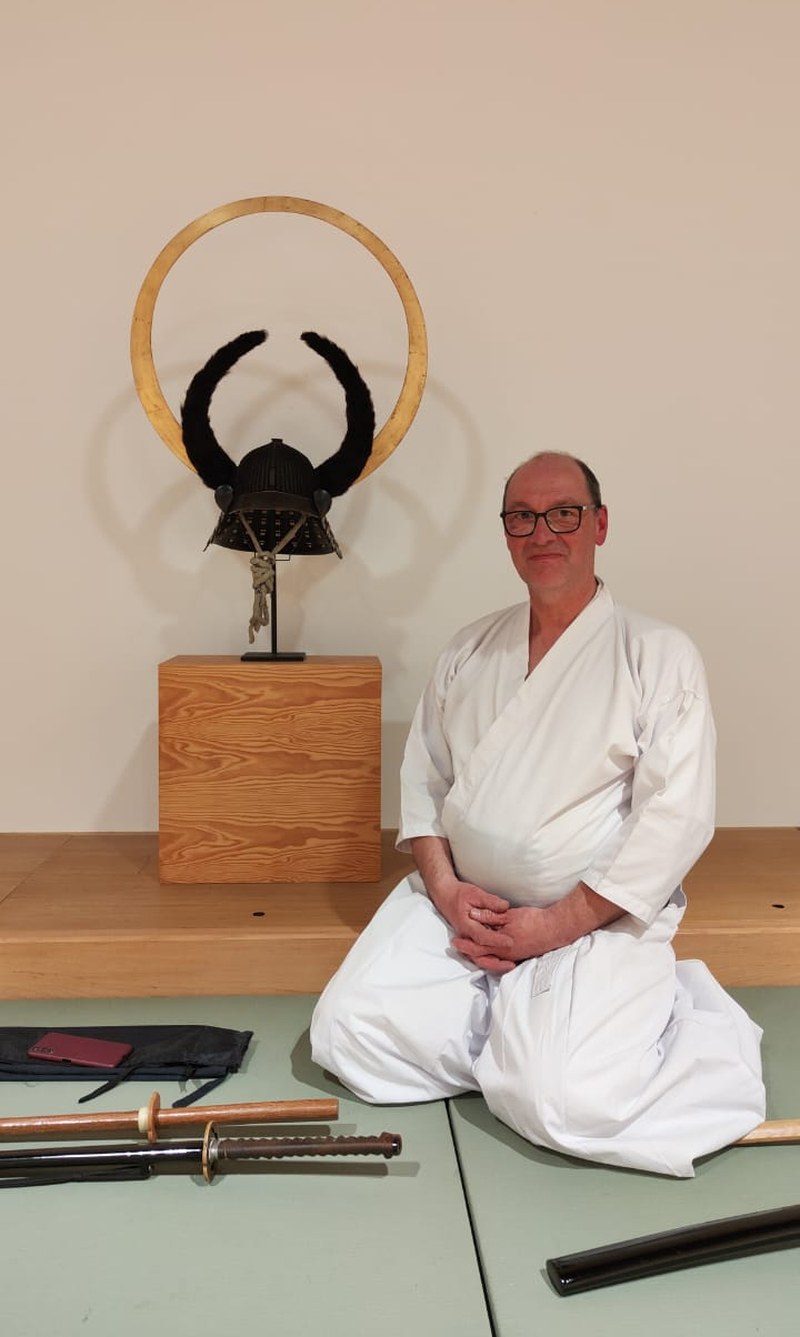
At Rŏgetsudō, Brussels — photo by Mukesh Gupta
From early 1993 Tomita taught iaijutsu as an inseparable companion to aikido, coining the term aiki‑iai to stress that the sword reveals what empty‑hand practice cannot. His aim was to transmit a universal principle that could be applied directly on the mat. He also passed on basic seiza no bu training and some more advanced techniques.
In Japan, Benoît de Spoelberch received the Kongen no Maki from Yamakoshi Masaki, he became a 21st‑generation carrier of the Musō Jikiden Eishin Ryū Yamauchi‑ha lineage. When he returned from Japan in 2010, I became one of his first students. His school is called Getsurinkai (月輪会). The circle was complete: the classical transmission we witnessed in Kyoto in 1997 was now accessible directly. While Tomita and Yamakoshi were friends and exchanged knowledge, Benoît's school focuses on preserving the historic forms and subtle internal principles of the classical school.
In recent years I received a fourth‑dan in iaijutsu from Nihon Iai Renmei, appreciating both the depth of the traditional lineage and the complementary, principle‑focused approach of Tomita's aiki‑iai. Thus I became a dedicated student of both AIKI and IAI. Ben sensei has built in Brussels a beautiful dojo called Rŏgetsudō at rue Renier Chalon where I practice weekly. His teaching enriched my aikido understanding profoundly. Next to Iai, he is a skilled kendoka and he is deeply involved in traditional Japanese culture; he organises Nō seminars and practices this art.
9. THE KRISHNAMURTI PATH
The Krishnamurti thread deepened steadily:
1999–present — Active participation in the Belgian Krishnamurti Committee, a reading group, video screenings, and co-organising weekends and a summer week in the Leerproject Association. Thank Stefaan for the Bohmday. Thanks Vicky for taking over the dialogue group of Ghent. Thank Peter, Jacomijn, Martijn,... to restructure Leerproject for the future.
2002–present — Regular retreats with P. Krishna, from 2008 at la Maison (France), and later with Mukesh Gupta (2012–now). Thanks Luc for volunteering there for many years. And of course Christiane.
These inquiries through dialogue and silence created space for unlearning — to allow deep listening, looking, and a different kind of learning — which gradually fed back into the aikido teaching, making the art of aiki less about technique and more about presence.
What Tomita sensei reveals through the body on the mat, Mukesh illuminates through inquiry into the nature of awareness itself — not analysing thought, but seeing directly what is. When something is seen deeply, it dissolves in that seeing. Both point to the same ground: when the self is not in the way, listening happens naturally. That silence, that stillness is listening — not me and you.
What Mukesh points to is this: we are almost always listening from our past — from conclusions, memories, the image we carry of ourselves and others. "When I am only listening from my knowledge, the listening is limited." But there is another quality of listening — one that does not depend on the past, that meets what is directly, without the filter of what we expect or fear.
In that listening, something quiets. Not by effort. By seeing.
In recent retreats, this seeing — this "shift from thought‑based living to attention‑based living" — began to move through the aikido as well. Not as something added to the practice, but as the ground from which the practice can now arise.
Stillness and action, as Mukesh says, are not separate.
I continue to support the work of Mukesh Gupta and his School for Self‑Inquiry, a community of fellow‑travellers, and immerse myself ever more into the silence of these retreats. Thanks Christiane, Anita, Leila, Ann, Susanne, Martine & Bruno, Julia, Roselyne, Gabrielle and many, many more!
10. PARALLEL PRACTICES
Alongside the main trajectory I followed along, several other disciplines have been constant companions — not as separate pursuits but as different doorways into the same quality of attention.
Hatha yoga accompanied the journey from the beginning and returned several times over the decades — with Eric Gomes (1981) as the first guide. I took up yoga a few times later on with Jules Buteyn (1986), Caroline Gallet (2008‑9) and in Leerproject and La Maison during Krishnamurti weekends and Mukesh retreats. Thanks Luc, Berry, Anita, Nicole. It repeatedly confirmed what the martial arts also emphasize: awareness of the body and mind are one.
Taijiquan Liu Wai‑sang introduced me to taijiquan in 1985 (Sabatini theatre, Ghent). His soft, relaxed, structurally aware approach profoundly influenced how I perceived aikido. Liu's first student, Marc De Bruyn, carried that insight forward teaching in Eeklo, and Liu's student Luc De Smet now teaches the approach in Bruges (2022–). This chain of teachers reinforced a more fluid, sensitive aikido style throughout my career.
Zazen and mindfulness Roland Rech's lectures on zazen at Ghent University drew me into sitting practice, which I took up in the Deshimaru lineage and later with Frank De Waele roshi (late 1990s). The thread continued quietly alongside everything else — in the zendo in Bruges, and then in a different emphasis when I did Mindfulness BSR training with Edel Maex and Jen Bertels in 2012, around the same time I first met Mukesh. In October 2024 I returned to Edel — this time seeing him not as a mindfulness trainer but as an authentic zen teacher. Sitting practice and self-inquiry were always pointing in the same direction.
11. WHERE THE PATHS MEET
Holding a sword makes the quality of attention instantly visible; when receiving an attack, no time & space between feeling and action can exist. All the disciplines — martial arts, yoga, taijiquan, zazen, Krishnamurti inquiry — converge on the same principle: deep, open listening. Receptivity with the whole being. The translation of the word IAI is "being in connection". That connection is what it is all about.
| Aikido | Fudōshin (不動心) — "immovable mind" — response arises naturally from stillness. |
| Iaijutsu | Isshin (一心) — "one mind" — kikentai'ichi (気剣体一), ki-sword-body-one. |
| Taijiquan | Jiran (自然) — naturalness. Movements flow without mental strain. |
| Zen | Wuxin/Mushin (無心) — no-mind. The mind and heart is without clinging. |
| Mindfulness | Mild, open attention. |
| Krishnamurti | Choiceless awareness. |
| Mukesh Gupta | Compassionate Presence. |
Although the vocabularies differ, each tradition points to the same ground of awareness.
→ Beyond Form: on takemusu aiki
12. WHAT STILL UNFOLDS
Over forty years, many names, many paths — yet the point is precisely this: you don't need any of it to listen with your whole being, with your heart, without preconceptions. Listening itself asks for nothing. It can happen now, directly, without the years of training.
In October 2025 I began teaching bi‑weekly at Ban Sen Juku, where Tomita Seiji — now 88 — still teaches when he can. As senior teacher, I convey Tomita's universal principle, seasoning it with my own insights and experience inspired by many. The Ban Sen Juku school is now overseen by a newly formed board, bringing a fresh wind to BSJ, with Tomita sensei's daughter Shino serving as head. Together with Tsu and a dedicated team of volunteer teachers we teach in the Brussels dojo. I would like to inspire all these instructors and anyone joining, fostering a collaborative environment where teaching is a living dialogue rather than a rigid transmission of forms.
Also I am now inviting likeminded people to walk with me in the woods around Bruges, sharing some meditative or aware walking and some basic body work based on what I learned over the years.
The story is not yet finished. It continues to develop, constantly returning to that core of presence and connection.
WOORD VAN DANK
Deze reis zou niet mogelijk zijn geweest zonder de talloze leraren, medestudenten en medewerkers die hun kennis, tijd en vrijgevigheid hebben gedeeld. Ook dank aan alle naamloze vrienden die door de jaren heen ruimte, muziek, eten en aanmoediging hebben geboden. Jullie steun heeft dit zich steeds verder ontvouwende pad vormgegeven.
Ik ben vooral Tomita Seiji zeer dankbaar — wiens universele principe de hoeksteen van mijn praktijk is geweest — en Mukesh Gupta, wiens presence en dialoog mijn begrip van luisteren en bewustzijn diepgaand hebben verdiept.
Het scherpe, veeleisende zwaard van iaijutsu, onderwezen door Ben sensei (en Yamakoshi sensei en de vele meesters vóór hen die hun vaardigheden en inzichten hebben doorgegeven), blijft mij op de meest uitdagende manier aansporen, waardoor zowel mijn techniek als mijn geest worden aangescherpt.
Het belangrijkste is dat ik alles te danken heb aan mijn ouders en mijn naaste omgeving – Kim, Marieken en Andreas. Hun onwankelbare steun, liefde en geloof hebben elke stap op dit pad mogelijk gemaakt.
Het pad in een oogopslag
Belangrijke momenten — het volledige verhaal volgt hieronder.
| 1981 | Hatha yoga (Eric Gomes). |
| Eerste kennismaking met de leer van J. Krishnamurti. | |
| 1983 | Begonnen met aikido (Sakura Mariakerke). |
| 1985 | Taijiquan — Liu Wai-sang-traditie. |
| 1986 | MA Japans & Klassiek Chinees, UGent (afgestudeerd in 1993). |
| 1988 | Eerste kennismaking met zazen (Roland Rech, Deshimaru-traditie). |
| 1991 | Behaalde zwarte gordel aikido — Georges Rousseau (Brusselse Aikido & Budo Federatie). |
| 1992 | Regelmatige leerling van Tomita Seiji Shihan — transformatieve verandering. |
| 1993 | Richtte BSJ Gent op met Henk Coudenys. |
| Begint met aiki-iai bij Tomita. | |
| 1997 | Japan — drie maanden iaijutsu bij Yamakoshi Masaki (20e generatie). |
| 1999 | De Bakermat dojo, Sint-Amandsberg (1999–2002). |
| 2002 | Retraites met P. Krishna — verdieping van het onderzoek in Krishnamurti teachings. |
| 2004 | Oprichting van Suishin dojo, Lembeke. |
| 2010 | Benoît de Spoelberch keert terug uit Japan — begin van koryu iaijutsu. |
| 2012 | Ontmoeting met Mukesh Gupta — verschuiving van een op denken gebaseerde, naar een op aandacht gebaseerde manier van leven. |
| 2018 | Behaalde 5e dan aikido (Tomita Shihan). |
| 2020 | Suishin dojo overgedragen aan Filip De Smet en Greet De Baets. |
| Behaalde 3e dan iaijutsu (Yamakoshi Masaki). | |
| 2022 | Healing taijiquan met Luc de Smet (onderbroken in 2026). |
| 2024 | Stille retraite met Edel Maex, professionele training. |
| 2025 | Behaalde 4e dan iaijutsu (Nihon Iai Renmei). |
| Geeft tweewekelijks les bij Ban Sen Juku Brussel. | |
| 2026 | Biedt meditatieve wandelingen aan in de bossen rond Brugge. |
1. DE EERSTE STAPPEN (1981–1985)
Mijn pad begon in 1981 in het Yoga Centrum in Gent, waar Eric Gomes hatha-yoga gaf en waar ik de boeken van J. Krishnamurti ontdekte. Die twee rode draden — leren via het lichaam en zelfonderzoek — werden de lenzen waardoor ik later elke beoefening zou bekijken.
Een korte kennismaking met karate (1980) en judo (1982) wekte mijn interesse in Budo (Japanse vechtkunsten) en leerde me hoe ik Ukemi (rollen en vallen) moest toepassen.
In 1983 begon ik met aikido bij Sakura Mariakerke, eerst bij Sinia Blondin en later bij Rudy Joliet. De club was een centrum voor het Belgische aikido; ik heb ook veel geleerd van sempai Jean Pierre Coppejans, Eric Verhertbruggen, Frank & Dirk Van Glabeke. Al vroeg reisden we samen naar Lille en Parijs om te trainen met Michel Bécart en nodigden we hem uit in onze Mariakerke dojo. Ik trainde bij hem van 1984 tot 1994, maar de zomercursus van 1987 was het intensiefst. In 1991 behaalde ik een shodan (eerste zwarte band) van de Belgische Aikido en Budo Federatie uit handen van Georges Rousseau, Georges Gailly, enz. Het was door de invloed van Rousseau dat Tamura sensei enkele privéseminars kwam geven — en ook door hem ontmoette ik Philippe Voarino (1991–94).
2. UNIVERSITEITSJAREN (1986–1993)
Tijdens mijn studie Japans en Klassiek Chinees aan de Universiteit Gent ontdekte ik de I Ching (Yijing) als een spiegel voor innerlijke patronen. Aikido-seminars met Sugano S sensei, Tamura N sensei en Yamada Y sensei verbreedden mijn technische basis. Ik was het meest onder de indruk van Kobayashi Hirokazu sensei en bleef zijn seminars bijwonen (1987–1994).
Nadat we samen naar Japan waren gereisd, heb ik een vriendschap en wetenschappelijke uitwisselingen onderhouden met Steven Trenson, nu universitair hoofddocent aan de Waseda‑universiteit in Tokio en een erkend expert op het gebied van esoterisch boeddhisme. Onze dialogen hebben mijn spirituele zoektocht gevoed en mij taalkundige en conceptuele inzichten geboden die mijn beoefening blijven verrijken.
3. EEN BEPALENDE KEUZE (1992)
Een demonstratie in 1990 door Tomita Seiji — die aikido, iaijutsu en de Japanse theeceremonie combineerde — maakte een blijvende indruk op mij. Vanaf 1992 volgde ik regelmatig lessen van Tomita sensei en parallel daaraan seminars bij Alain Peyrache. Het werd duidelijk dat het lichaam al deze verschillende benaderingen niet meer aankon. Tomita sensei maakte het duidelijk: blijf bij één leraar. Bij het vertalen van Kisshomaru Ueshiba's oude aikido-handleiding voor mijn masterscriptie ontdekte ik een passage die perfect aansloot bij Tomita's principe: evenwicht vinden door contact. Eind 1993 besloot ik me toe te leggen op Tomita's lessen, richtte ik een dojo op en assisteerde ik hem in Gent. Deze beslissing was bepalend voor alles wat daarna kwam.
4. EEN FUNDAMENT LEGGEN (1992–1998)
Na ongeveer een jaar training in de dojo in Elsene, in de Malibranstraat, richtte ik samen met Tomita sensei en Henk Coudenys de BSJ-dojo in Gent op. Tomita's wekelijkse lessen waren zeer verrijkend en intensief. Op donderdag gaf ik les over wat we net op dinsdag hadden geleerd. Vijf jaar lang hebben we een kleine maar toegewijde gemeenschap opgebouwd en een stabiele groep leerlingen gekweekt (Marc Eliaert, Erwin Sevens, Wim Vervaeke, Steven Trenson, Jorgen Van der Beken, Joeri Gydé en nog vele anderen). De basis voor een diepe vriendschap met deze sensei was klaar om zich te ontvouwen als een delicate bloem.
De eerste jaren dat ik lesgaf in Gent, volgde ik op maandag lessen van sensei in Antwerpen. Sempai daar waren Frank van Hoeck, Mieke De Borger, Jurgen De Beule, Marij Uytdenbogaert, Theo Korn, enz.
5. KYOTO (1997)
Tijdens een zomer-herfstreis naar Japan (we trainden aikido in Takeuchi dojo en in de buurt van het station van Kyoto) maakten Steven Trenson en ik kennis met Yamakoshi Masaki, een 20e-generatie meester van Musō Jikiden Eishin Ryū. Door met hem te trainen werd het diepe historische en structurele verband tussen zwaardvechten en aikido duidelijk. De reis bevestigde dat de eerdere keuze voor Tomita juist was geweest: de beste aikido-leraren woonden in België. Veel dank aan Yamakawa sensei en Tsukimoto sensei voor hun begeleiding tijdens deze reis.
6. MIJN EIGEN WEG VINDEN (1996–2002)
Vanaf 1996 gaf ik aikido bij Capitol, een zelfverdedigingsacademie in Gent — een ervaring die duidelijk maakte in welke omgeving aikido tot bloei kan komen. In 1998 nam ik ontslag bij BSJ Gent om een meer onafhankelijke koers te varen.
Daarna opende ik een bescheiden ruimte in Sint‑Amandsberg — De Bakermat — waar ik aikido, taijiquan, zazen, yoga, door Krishnamurti geïnspireerde activiteiten en aanverwante kunsten aanbood. Door financiële druk moest ik na drie jaar sluiten, maar de geest van het zien van de verbinding tussen disciplines bleef bestaan. Veel dank aan de velen die hebben geholpen om dit op te bouwen: Corinne Debroye, Stefaan Six, Kaatje De Porre, Paul Mussche, Brigitta Cocquyt, Dora Smeesters, Els Cottyn, Ingrid Vervondel, Marnix Vermaercke, Herman Meirhaeghe, Attila Kadar en in het bijzonder Lieven De Smedt.
In de periode 2001‑02 gaf ik ook zelfverdedigingscursussen voor Securitas (Securis). Hier ontmoette ik Jean Marie, een tai‑chi‑leraar en vechtsporter die door de jaren heen contact bleef houden.
7. SUISHIN LEMBEKE (2004–2020)
Op zoek naar een rustigere omgeving richtte ik Suishin dojo op in het landelijke dorpje Lembeke. Vijftien jaar lang trainde daar een kleine, stabiele groep, geïnspireerd door de universele principes van Tomita. De beoefening werd later verrijkt door Ben sensei (vanaf 2010), een gevorderde leerling van Yamakoshi sensei die ik in 1997 had ontmoet.
Twee BSJ-sempai hebben mij veel bijgebracht: Frank van Hoeck in zijn dojo in Stekene (1999–2002 & 2020–22) en Sep Overlaet in de Antwerpse dojo (2005–7).
In 2018 ontving ik de graad van 5e dan van Tomita sensei. Rond 2019‑2020 droeg ik de dojo over aan Filip De Smet en Greet De Baets. Een openluchtdojo in de bossen van Lembeke overbrugde de pandemieperiode. De band met BSJ werd sterker. Greet promoveerde later op aikido en communicatie (2025) en is nu lid van het BSJ-bestuur.
8. HET IAIJUTSU-PAD — PRINCIPE EN OVERDRACHT
In Rŏgetsudō, Brussel — foto door Mukesh Gupta
Vanaf begin 1993 onderwees Tomita iaido als een onlosmakelijk onderdeel van aikido en bedacht hij de term aiki‑iai om te benadrukken dat het zwaard onthult wat met lege handen niet kan worden bereikt. Zijn doel was om een universeel principe over te brengen dat direct op de mat kon worden toegepast. Hij gaf ook basislessen in seiza no bu en enkele meer geavanceerde technieken.
In Japan ontving Benoît de Spoelberch de Kongen no Maki van Yamakoshi Masaki en werd hij de 21e generatie drager van de Musō Jikiden Eishin Ryū Yamauchi‑ha-traditie. Toen hij in 2010 terugkeerde uit Japan, werd ik een van zijn eerste leerlingen. Zijn school heet Getsurinkai (月輪会). De cirkel was rond: de klassieke overdracht die we in 1997 in Kyoto hadden gezien, was nu rechtstreeks toegankelijk. Terwijl Tomita en Yamakoshi vrienden waren en kennis uitwisselden, richt de school van Benoît zich op het behoud van de historische vormen en subtiele interne principes van de klassieke school.
De afgelopen jaren heb ik van Nihon Iai Renmei een vierde dan in iaijutsu ontvangen en waardeer ik zowel de diepgang van de traditionele afstamming als de complementaire, op principes gerichte benadering van Tomita's aiki‑iai. Zo werd ik een toegewijde leerling van zowel AIKI als IAI. Ben sensei heeft in Brussel een prachtige dojo gebouwd, genaamd Rŏgetsudō, in de Renier Chalonstraat, waar ik wekelijks train. Zijn lessen hebben mijn begrip van aikido enorm verrijkt. Naast Iai is hij een ervaren kendoka en is hij zeer betrokken bij de traditionele Japanse cultuur; hij organiseert Nō-seminars en beoefent deze kunst.
9. HET KRISHNAMURTI‑PAD
De rode draad van Krishnamurti werd steeds sterker:
1999–heden — Actieve deelname aan het Belgisch Krishnamurti Comité, een leesgroep, videovertoningen, en medeorganisatie van weekenden en een zomerweek in de Leerproject Association. Dank aan Stefaan voor de Bomh-dag. Dank aan Vicky voor het overnemen van de dialooggroep van Gent. Dank aan Peter, Jacomijn, Martijn,... voor het herstructureren van Leerproject voor de toekomst.
2002–heden — Regelmatige retraites met P. Krishna vanaf 2002, vanaf 2008 in la Maison (Frankrijk), later met Mukesh Gupta (2012–heden). Dank aan Luc voor zijn jarenlange vrijwilligerswerk daar. En natuurlijk aan Christiane.
Deze onderzoeken door middel van dialoog en stilte creëerden ruimte voor het ontleren — om diep te kunnen luisteren, kijken en een ander soort leren mogelijk te maken — wat geleidelijk terugkwam in het lesgeven van aikido, waardoor de kunst van aiki minder over techniek en meer over presence ging.
Wat Tomita sensei onthult via het lichaam op de mat, belicht Mukesh door onderzoek naar de aard van bewustzijn zelf — niet door gedachten te analyseren, maar door direct te zien wat er is. Wanneer iets diep wordt gezien, lost het op in dat zien. Beiden wijzen op hetzelfde grondbeginsel: wanneer het zelf niet in de weg staat, gebeurt luisteren vanzelf. Die stilte, die verstilling is luisteren — niet ik en jij.
Wat Mukesh aangeeft is dit: we luisteren bijna altijd vanuit ons verleden — vanuit conclusies, herinneringen, het beeld dat we van onszelf en anderen hebben. "Als ik alleen luister vanuit mijn kennis, is het luisteren beperkt." Maar er bestaat een andere kwaliteit van luisteren — een die niet afhankelijk is van het verleden, die direct ontmoet wat er is, zonder de filter van wat we verwachten of vrezen.
In dat luisteren ontstaat rust. Niet door inspanning. Door te zien.
Tijdens recente retraites begon dit zien — deze "verschuiving van een op denken gebaseerd leven naar een op aandacht gebaseerd leven" — door te dringen in aikido. Niet als iets dat aan de beoefening werd toegevoegd, maar als de basis van waaruit de beoefening nu kan ontstaan.
Stilte en actie staan, zoals Mukesh zegt, niet los van elkaar.
Ik blijf het werk van Mukesh Gupta en zijn School for Self‑Inquiry ondersteunen, een gemeenschap van mede‑reizigers, en dompel mezelf steeds meer onder in de stilte van deze retraites. Bedankt Christiane, Anita, Leila, Ann, Susanne, Martine & Bruno, Julia, Roselyne, Gabrielle en nog vele, vele anderen!
10. PARALLELE BEOEFENINGEN
Naast het hoofdtraject dat ik heb gevolgd, zijn verschillende andere disciplines constante metgezellen geweest — niet als afzonderlijke bezigheden, maar als verschillende toegangen tot dezelfde kwaliteit van aandacht.
Hatha yoga begeleidde de reis vanaf het begin en keerde meerdere keren terug gedurende de decennia — met Eric Gomes (1981) als eerste gids. Ik ben later een paar keer met yoga begonnen bij Jules Buteyn (1986), Caroline Gallet (2008‑9) en in Leerproject en La Maison tijdens Krishnamurti‑weekends en Mukesh-retraites. Bedankt Luc, Berry, Anita, Nicole. Het bevestigde herhaaldelijk wat de vechtsporten ook benadrukken: bewustzijn van lichaam en geest zijn één.
Taijiquan Liu Wai‑sang liet me in 1985 kennismaken met taijiquan (Sabatini theater, Gent). Zijn zachte, ontspannen en structureel bewuste aanpak had een grote invloed op hoe ik beweging in aikido zag. Liu's eerste leerling, Marc De Bruyn, zette die visie voort in zijn lessen in Eeklo, en Liu's leerling Luc De Smet geeft nu les in Brugge (2022–). Deze keten van leraren heeft gedurende mijn hele carrière bijgedragen aan een meer vloeiende, gevoelige aikidostijl.
Zazen en mindfulness De lezingen van Roland Rech over zazen aan de Universiteit van Gent trokken me naar de zitmeditatie, die ik begon in de Deshimaru-traditie en later bij Frank De Waele roshi (eind jaren 90). De rode draad liep stilletjes door naast al het andere — in de zendo in Brugge, en vervolgens in een ander register toen ik in 2012 een Mindfulness BSR-training volgde bij Edel Maex en Jen Bertels, rond dezelfde tijd dat ik Mukesh voor het eerst ontmoette. In oktober 2024 keerde ik terug naar Edel — dit keer zag ik hem niet als een mindfulness-trainer, maar als een authentieke zenleraar. Zitmeditatie en zelfonderzoek wezen altijd in dezelfde richting.
11. WAAR DE PADEN SAMENKOMEN
Het hanteren van een zwaard maakt de kwaliteit van de aandacht onmiddellijk zichtbaar; wanneer je wordt aangevallen, kan er geen tijd en ruimte bestaan tussen gevoel en actie. Alle disciplines — vechtsporten, yoga, taijiquan, zazen, Krishnamurti‑onderzoek — komen samen in hetzelfde principe: diep, open luisteren. Ontvankelijkheid met het hele wezen. De vertaling van het woord IAI is "in verbinding zijn". Die verbinding is waar het allemaal om draait.
| Aikido | Fudōshin (不動心) — 'onbeweeglijke geest' — reactie komt vanzelf voort uit stilte. |
| Iaijutsu | Isshin (一心) — 'één geest' — kikentai'ichi (気剣体一), ki-zwaard-lichaam-één. |
| Taijiquan | Jiran (自然) — natuurlijkheid. Bewegingen vloeien zonder mentale spanning. |
| Zen | Wuxin/Mushin (無心) — geen geest. De geest en het hart zijn zonder gehechtheid. |
| Mindfulness | Milde, open aandacht. |
| Krishnamurti | Keuzeloos gewaarzijn. |
| Mukesh Gupta | Presence vanuit medeleven. |
Hoewel het vocabulaire verschilt, wijst elke traditie naar dezelfde grond van bewustzijn.
→ Voorbij de vorm: over takemusu aiki
12. WAT ZICH NOG ONTWIKKELT
Gedurende veertig jaar, vele benamingen, vele paden — maar het essentiële is dit: je hebt niets van dit alles nodig om met je hele wezen, met je hart, zonder vooroordelen te luisteren. Luisteren op zich vraagt niets. Het is nu mogelijk, direct, zonder jarenlange training.
In oktober 2025 begon ik tweewekelijks les te geven bij Ban Sen Juku, waar Tomita Seiji — nu 88 — nog steeds lesgeeft wanneer hij kan. Als senior docent breng ik Tomita's universele principe over, gekruid met mijn eigen inzichten en ervaringen, geïnspireerd door velen. De Ban Sen Juku-school staat nu onder toezicht van een nieuw gevormd bestuur, dat een frisse wind door BSJ laat waaien, met Tomita sensei's dochter Shino als hoofd. Samen met Tsu en een toegewijd team van vrijwillige leraren geven we les in de dojo in Brussel. Ik wil al deze instructeurs en iedereen die zich aansluit inspireren en een samenwerking bevorderen waarin lesgeven een levendige dialoog is in plaats van een rigide overdracht van vormen.
Ook nodig ik nu gelijkgestemde mensen uit om met mij te wandelen in de bossen rond Brugge, waarbij we meditatief of bewust wandelen en enkele basisoefeningen doen op basis van wat ik in de loop der jaren heb geleerd.
Het verhaal is nog niet ten einde. Het blijft zich ontwikkelen en keert steeds terug naar die kern van presence en verbinding.